

Direct Answer: Read your card for the plan type, call the carrier and ask about your remaining maximum, deductible, coverage percentages and out-of-network reimbursement, then request a written pre-treatment estimate for larger work.
Roughly one in five calls that reach our front desk opens the same way: “Do you take my insurance?” Most callers name a plan outright. Delta Dental PPO comes up most, then GEHA, Humana, UnitedHealthcare and Cigna.
And here is what I see happen more than I’d like. Someone hears that a plan isn’t in network and hangs up within seconds, even though a PPO often still pays a share toward care at an out-of-network office. They never find out what their plan would actually have covered.
So I want to hand you the sequence I’d run myself. It takes about 20 minutes, it works for any dental office in Renton or anywhere else in South King County, and it tells you what your plan will pay before you’re reclined in a chair with a bib clipped on.
Step 1: Read the card, not the logo on the front
The carrier name tells you less than people assume. The plan type printed on the card is what actually controls your money.
A PPO generally pays a percentage toward care whether the dentist is in network or out, though the math changes when they’re out. A DHMO usually assigns you to one contracted office and pays little or nothing anywhere else. An EPO sits closer to the DHMO side. A discount plan is not insurance at all, it’s a negotiated fee list.
Before you pick up the phone, pull the card out and find these four things:
- Plan type (PPO, DHMO, EPO, or discount), usually printed near the logo or under the plan name
- Member ID, sometimes listed as subscriber ID
- Group number, which ties you to your employer’s specific plan design
- Member services phone number, almost always on the back
If the card doesn’t say the plan type anywhere, your benefits portal or your HR summary will. It’s worth the extra two minutes. A deeper breakdown lives in our guide to what your dental card controls in Washington.

Step 2: Call the carrier and ask these exact questions
This is the call most people skip. It’s also the one that prevents the January surprise.
Dial the member services line on the back of the card and have your member ID ready. Then work through the list below without rushing. Representatives answer these questions all day and will not be annoyed.
- What is my remaining annual maximum, and what date does it reset?
- Has my deductible been met for this benefit year, and how much is it?
- What percentage does the plan pay for preventive, basic and major categories?
- What are the frequency limits on cleanings, exams and X-rays?
- Are there waiting periods on major work like crowns or periodontal surgery?
- How are out-of-network claims reimbursed, and against what fee schedule?
That last question is where surprise balances come from. Many plans pay out-of-network claims against a maximum allowable fee set by the carrier, which may not match what offices in Renton or Kent actually charge. The gap becomes your balance.
Before you hang up, write down the reference number and the name of the representative. Benefit quotes given over the phone are not binding, and that reference number is the only trail you’ll have if the claim comes back differently.
The Carrier Call, Question by Question
Keep this next to you during the call. The right column is what to actually write down, because “it’s covered” is not an answer you can use later.
| Ask the carrier | Why it matters | Write down |
|---|---|---|
| Remaining annual maximum and reset date | Tells you how much the plan will still pay this year | Dollar figure and exact reset date |
| Deductible amount and whether it’s met | Comes off the top before the plan pays anything | Amount met and amount remaining |
| Coverage percentage by category | Preventive, basic and major are paid at different rates | Three separate percentages |
| Frequency limits on cleanings and X-rays | A second cleaning too soon can be denied outright | Visits allowed per 12 months and last date used |
| Waiting periods on major work | New plans often delay crowns and perio treatment | Months remaining, if any |
| Out-of-network reimbursement method | Explains where balance bills come from | Fee schedule name and payment percentage |
| Reference number and rep name | Your only record if the quote turns out wrong | Both, with the call date |
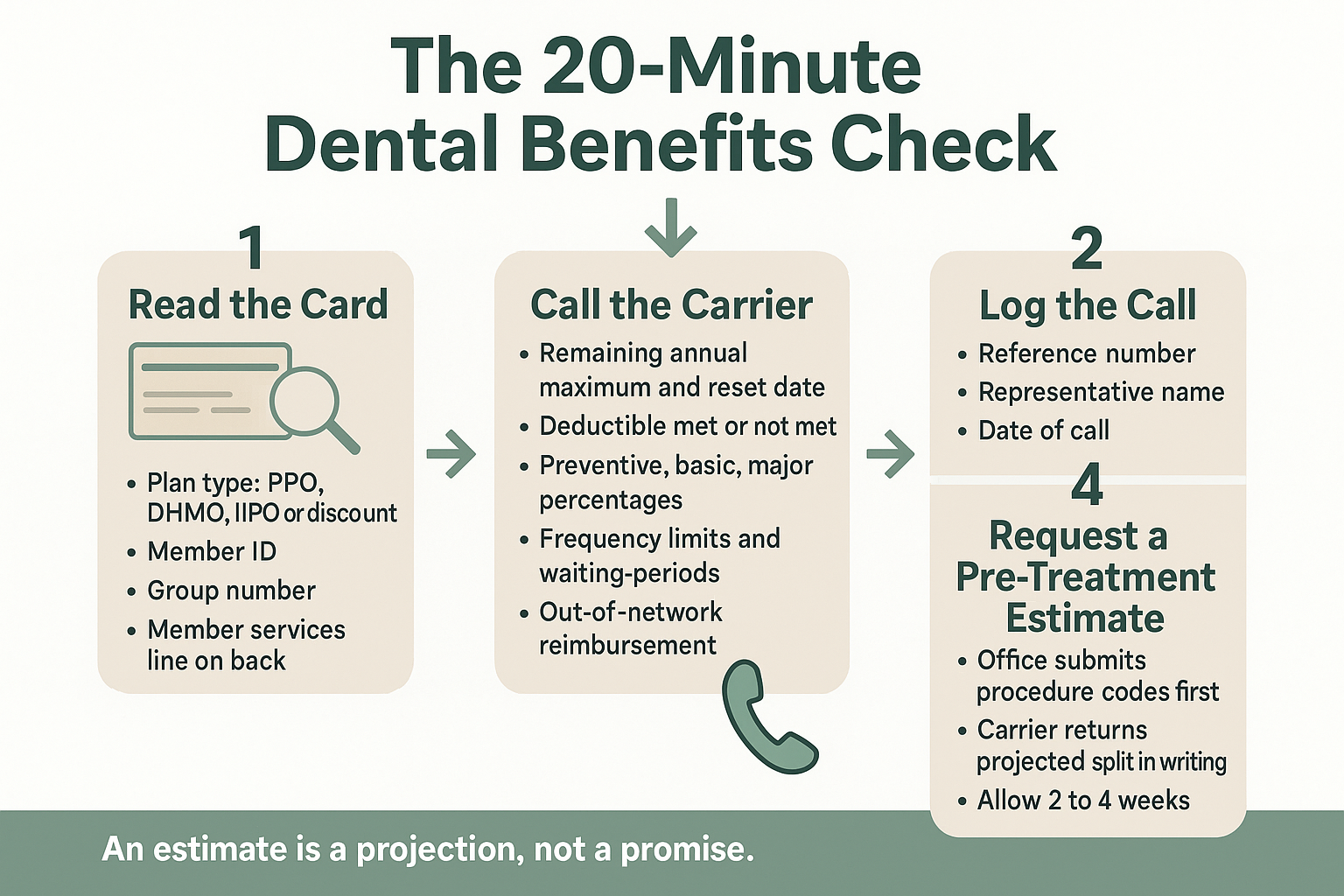
The 20-Minute Benefits Check, Start to Finish
Here is the whole sequence on one page, from the card in your wallet to a written estimate in your hand.
Step 3: Ask for a pre-treatment estimate before anything gets scheduled
Almost nobody knows to ask for this one, and it’s the step that settles the most arguments.
For larger work like a crown, a root canal or periodontal treatment, a dental office can submit the planned procedure codes to your carrier before the appointment is booked. The carrier sends back a projection of what it expects to pay and what it expects you to owe, in writing.
I’ll be straight with you about what it is and isn’t. A pre-treatment estimate is a projection based on what the plan says today, not a promise. The final bill can shift if a code changes during treatment or if the plan applies a limitation nobody caught up front.
It still beats the alternative. I’ve heard from patients who were told verbally that a service would be partly covered, then got a denial weeks later. Nobody was acting in bad faith. A verbal reassurance just isn’t a document.
The codes on that estimate are worth understanding too, since one letter and four digits decide which coverage category a procedure falls into. We walk through that in what the D-codes on your dental estimate mean.
Plan on two to four weeks for a carrier to turn an estimate around. If treatment is time sensitive, say so, and ask what the office recommends in the meantime.
What a dental office can tell you, and what it genuinely cannot
We verify benefits and submit claims as a courtesy, and we’re glad to do it. But the contract is between you and your plan. The plan is the only authority on what it will pay.
That distinction matters on cost. Any number quoted over the phone before an exam is a broad range, because the same aching tooth can turn out to need very different treatment. Callers tell us all the time that three offices gave them three different figures for the same procedure, and usually that’s because three offices were picturing three different treatments.
Annual maximums are the other ceiling worth knowing about. Across most plans we see, the annual cap still tends to land somewhere in the $1,000 to $1,500 range, which is why larger treatment plans often get staged across two benefit years on purpose.
One more thing about network status. The American Dental Association has addressed how often patients misread out-of-network benefits, including the common belief that you may only see an in-network dentist, and points to clear network disclosure and a written financial policy as the accepted standard. You can read their discussion of out-of-network billing.
A patient nearby wrote to us this summer in exactly that spot: their longtime dentist had gone out of network, they carried Regence, and they wanted network status confirmed before booking a simple cleaning. That’s the right instinct. More on it in our piece on what PPO network changes mean for your plan.
Why this fall is the time to run the check in Renton
Plan changes don’t trickle in around here. They arrive in a cluster, then show up as network surprises in January.
The calendar is specific this year:
- Medicare Annual Enrollment: October 15 through December 7, 2026
- Washington Healthplanfinder open enrollment: November 1, 2026 through January 15, 2027, with December 15 as the deadline for coverage starting January 1
- Most employer open enrollment: October and November
Renton is a benefits-heavy city. The 737 final assembly plant anchors the local economy, and health care and manufacturing sit among the largest employment sectors here, so a lot of households re-elect coverage in the same six-week window.
Then February arrives and the claims come back. The fix is unglamorous: verify the new plan year’s network and benefits before your first appointment of the year, not in March after a claim is processed.
If you also have unused benefits sitting on this year’s plan, that’s a separate clock. We covered it in what happens when your dental benefits reset in January.
Frequently Asked Questions About Checking Dental Benefits
If a dentist is out of network with my PPO, does my insurance pay nothing?
Usually that’s not the case. A PPO typically still pays a percentage toward care at an out-of-network office, just calculated against a different fee schedule. The part worth asking about is how the carrier sets that allowable fee, because the gap between it and the office’s fee is what you’d owe. A DHMO works differently and generally does restrict you to an assigned office.
Can the dental office just tell me what I’ll owe when I call?
We can verify your benefits and give you a general range, but an honest number needs an exam. The same tooth can need a filling or a crown depending on what the X-ray shows, and those are different coverage categories.
How long does a pre-treatment estimate take?
Commonly two to four weeks, depending on the carrier. It’s worth the wait on crowns, root canals and periodontal treatment. For a routine cleaning and exam, a standard benefits verification is usually enough.
The carrier told me something was covered and it got denied anyway. What went wrong?
Phone quotes are not binding, and that catches people off guard. Frequency limits, waiting periods and missing-tooth clauses often don’t surface in a quick verbal check. That’s why I push people toward the written estimate and toward saving the reference number from every benefits call.
What if I don’t have dental insurance at all?
Then skip the carrier steps and go straight to asking about fees, treatment sequencing and payment plans. Plenty of patients in Renton, Tukwila and Newcastle pay out of pocket and simply schedule larger work in stages.
Want your benefits looked at before you schedule?
One thing worth saying plainly: a referral to an outside specialist usually means a second network check, a second deductible conversation and a second set of claims. Because a board-certified periodontist and an in-house endodontist practice alongside Dr. Chu here in Renton, periodontal surgery and root canal care generally stay inside one treatment plan and one billing conversation. We accept most major PPO plans and work with Cherry and Sunbit for patients without coverage, and anyone who wants their own benefits reviewed before booking is welcome to reach Cedar Dental Group at 425-430-0400 or at cedardentalgroup.com.
