
Direct Answer: Most PPO dental plans reset every January 1 and unused annual maximums do not carry over. Crowns, implant crowns, and periodontal surgery usually fall under major restorative coverage at roughly 50 percent.
If you have a crown, an implant restoration, or a gum procedure sitting in your treatment plan right now, there is a financial clock running that has nothing to do with your teeth. Most PPO dental plans in Washington run on a calendar year, and whatever is left of your annual maximum on December 31 simply disappears. It does not roll over.
I hear this from patients in Renton every fall. Someone comes in for a cleaning in March, gets told they need a crown, thinks about it for six months, and then calls in December hoping to squeeze it in before the reset.
This article is not about pressure. It is about how dental insurance in Washington state handles major restorative work, why the number you get quoted sometimes does not match the bill, and how to plan around all of it with your eyes open.
Preventive, Basic, and Major: The Three Tiers That Decide What You Pay
Almost every PPO plan sorts procedures into three buckets, and the bucket matters more than the procedure itself. Patients are often surprised by which bucket their treatment lands in.
- Preventive covers cleanings, exams, and X-rays. These are usually paid at 100 percent with no deductible and no waiting period.
- Basic covers fillings, simple extractions, and often scaling and root planing for gum disease. Typically paid at around 80 percent after your deductible.
- Major restorative covers crowns, bridges, dentures, implant crowns, and surgical periodontal procedures. Typically paid at around 50 percent after your deductible, and often subject to a waiting period of 6 to 12 months on newer plans.
That waiting period trips people up more than anything else. If you started a new plan in March after a job change, your crown may not be covered until the following spring, even though your cleanings were covered from day one.
The other ceiling is the annual maximum. Many plans cap total benefits somewhere in the low thousands per year, and once you hit it, the plan stops paying regardless of what you still need. Our older guide on how dental insurance works in Washington, and where it falls short goes deeper on that ceiling.
Why Late Summer Through November Is the Practical Window
Here is the timing math I walk patients through. By late summer, most people who keep up with two cleanings a year have already met their deductible through earlier visits, and a meaningful chunk of their annual maximum is still sitting unused.
That combination is the friendliest point in the year for major work. You are past the out-of-pocket hurdle and still have benefit dollars available.
There is also a lab timing factor people forget. A crown, a bridge, or an implant restoration involves outside lab work, and between the preparation appointment, the lab turnaround, and the seat appointment, you are usually looking at two to four weeks from start to finish.
Start that process in mid-December and the seat date can easily land in January, which means the claim processes against the new year’s benefits. Not a disaster, but not what most people expect.
There is one situation where waiting actually helps. If you have a large plan and need two major procedures, splitting them across two benefit years can let you draw from two separate annual maximums instead of blowing through one. We cover that sequencing idea in more detail in what a January benefits reset actually means.
How PPO Plans Typically Sort Common Procedures
Coverage percentages vary by plan, so treat this as a general map rather than a promise. Your own plan documents are the final word.
| Procedure | Usual Tier | Typical Plan Behavior |
|---|---|---|
| Cleaning, exam, X-rays | Preventive | Often 100 percent, no deductible, no waiting period |
| Composite filling | Basic | Often around 80 percent after deductible |
| Scaling and root planing | Basic | Often around 80 percent, may require documented pocket depths |
| Dental crown | Major restorative | Often around 50 percent, waiting period common on new plans |
| Periodontal surgery (flap surgery) | Major restorative | Often around 50 percent, frequently requires pre-authorization |
| Bone graft | Major restorative | Sometimes covered, sometimes excluded, depends on the reason coded |
| Implant fixture | Varies | Excluded entirely on many plans |
| Teeth whitening | Cosmetic | Almost never covered |
The Three Numbers That Decide Your Out-of-Pocket Cost
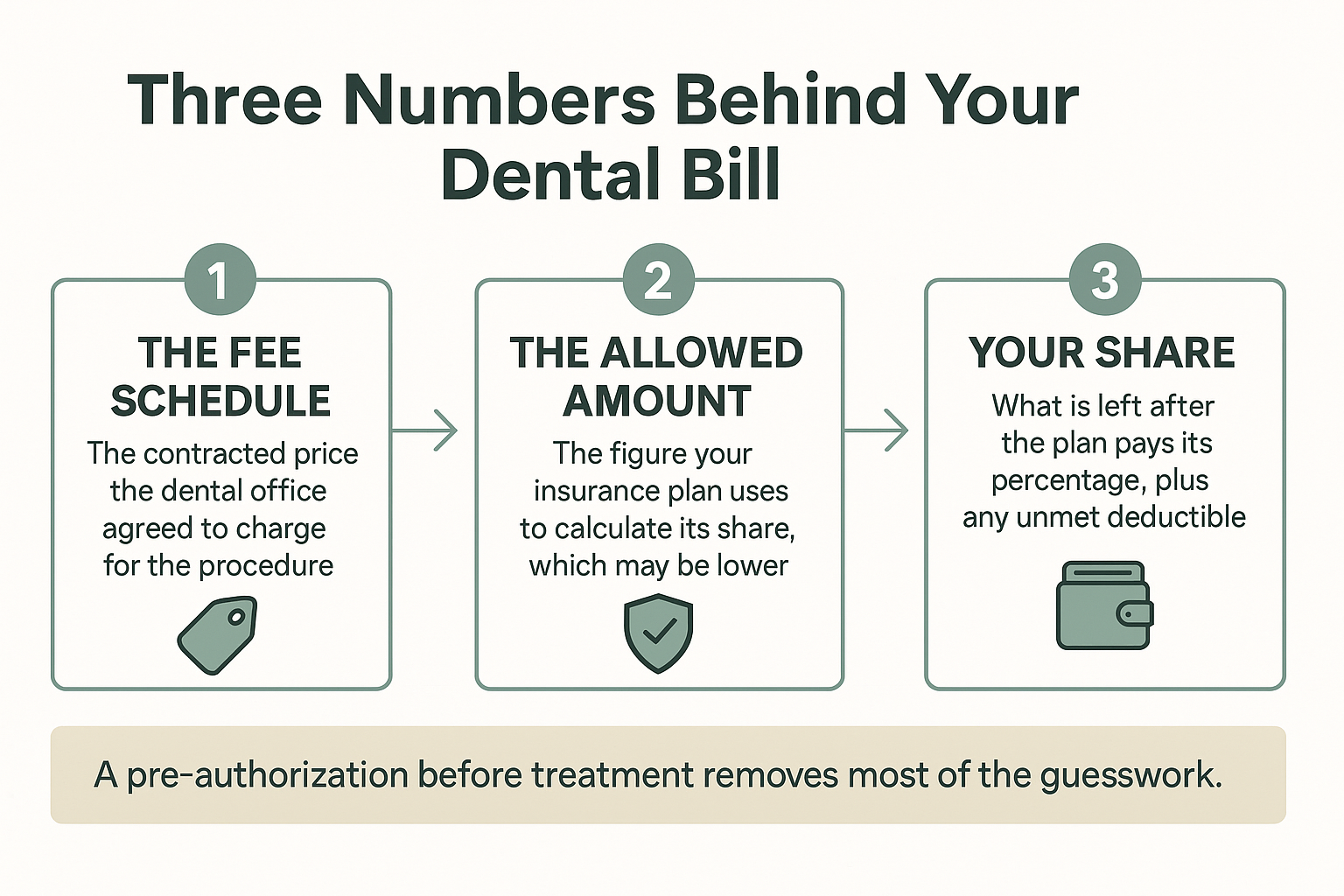
Most billing confusion comes down to three separate figures that patients assume are the same number. They are not.
Why the Quote You Got Does Not Always Match the Bill
This is the single most common frustration I hear on the phone, and it is almost always the same mechanism. A dental office quotes your estimate based on the contracted fee schedule, which is the price the office agreed to charge under its network contract.
Your plan, meanwhile, calculates its payment against its own allowed amount for that procedure code. When those two figures do not line up, the difference lands on the patient, and it shows up weeks later after the claim processes.
A few things reduce that gap considerably:
- Ask the office to submit a pre-authorization (some plans call it a pre-determination) before major work. The plan responds in writing with what it expects to pay.
- Call your insurance company yourself and ask for a benefit estimate by procedure code. Your office can give you the codes.
- Confirm your remaining annual maximum and whether your deductible has been met in the same call.
- Ask specifically about frequency limits, since some plans replace a crown only once every five to seven years.
When your explanation of benefits (EOB) arrives, read the line that says “not a bill.” That document is your plan telling you what it paid and what it left to you. It is not a demand for payment, and it is your best tool for checking whether the office billed what you were quoted.
Implants Are Not One Charge, They Are Several
Patients weighing an implant after tooth loss run into a coverage structure that surprises them. Many PPO plans exclude the implant fixture entirely, meaning the titanium post placed in the jawbone.
But the procedures around it are billed as separate line items. The bone graft, if one is needed to rebuild jaw structure before placement, and the implant crown that goes on top may each be considered under major restorative benefits.
So the honest answer to “does my insurance cover implants” is usually partial. Understanding which pieces your plan pays for lets you budget the real number instead of a guess, and it lets you sequence the graft and the restoration in a way that draws from available benefits.
Dr. Jaewon Kim, our board-certified periodontist, handles bone grafting and periodontal surgery here in the office, and Dr. Susan Chu handles the restorative side. That matters for insurance because treatment done under one roof means one office coordinating the claim rather than two offices submitting separately. If you want the full cost picture, the actual breakdown of what goes into dental implant cost walks through each component.
Gum grafting follows its own coverage logic, which we untangled separately in when a gum graft is covered by insurance and when it is not.
If You Lapsed on Coverage After a Job Change
A fair number of people in Renton, Kent, and Tukwila drop dental coverage during a job transition and never pick it back up. If you are staring at major work with no plan at all, it is worth checking what stand-alone dental costs.
Individual dental plans bought through Washington Healthplanfinder, the state’s health benefit exchange, also run on a calendar year. Reported premium ranges for 2026 individual dental plans have been cited in the neighborhood of roughly $18 to $47 per month, though your actual rate depends on the plan and your county.
Just remember the waiting period rule. A brand new plan will usually cover your cleaning right away and make you wait several months for a crown, so buying coverage the week before major treatment rarely works the way people hope.
Frequently Asked Questions About Washington PPO Benefits and Major Dental Work
Does my unused dental maximum really disappear on January 1?
On a calendar-year plan, yes. Unused annual maximum does not roll over. A small number of plans run on a plan year tied to your employer’s benefit start date instead, so check which one you have before assuming December is your deadline.
Do you accept Delta Dental PPO, GEHA, Humana, and UnitedHealthcare?
Those four come up on our phones constantly. We accept most major PPO plans, and the accepted list is on our website, but the more useful step is having your specific benefits verified, since two people with the same carrier can have very different coverage percentages and maximums.
What does “not a bill” mean on my explanation of benefits?
It means the document is a summary from your insurance company, not a request for payment. It shows the submitted charge, the allowed amount, what the plan paid, and what portion was assigned to you. The actual bill comes from the dental office, and the two should line up.
Should I get a second opinion if I was quoted a high number for a crown or root canal?
Getting a second opinion is reasonable and no good dentist will take it personally. What I would add is that quotes are hard to compare unless both offices are estimating against the same plan, the same procedure codes, and the same material choices. Ask what is included before you compare two numbers side by side.
Can I split a treatment plan across two benefit years?
Often, yes, if the clinical situation allows for it. Splitting works well when you need two separate major procedures and neither one is time sensitive. It works poorly when a tooth is actively deteriorating, so this is a conversation to have with your dentist rather than a decision to make on your own.
Want a Clear Read on What Your Plan Will Actually Pay?
If you have a treatment plan sitting in a drawer and you are not sure how much of it your benefits will cover, we are happy to verify your plan and walk through the numbers with you before anything is scheduled. Patients from Renton, Kent, Tukwila, Burien, and Newcastle can reach our office at 425-430-0400 or find more information at cedardentalgroup.com. No pressure either way, just a clearer picture than the one most people start with.
