
Direct Answer: A single-tooth dental implant typically ranges from $3,000 to $7,000 depending on whether bone grafting, sedation, or other preparatory procedures are needed before the implant itself is placed.
One of the most common questions I hear — and honestly one of the most reasonable ones — is some version of: ‘I just want to know what this is going to cost me.’ Implants in particular seem to carry a price tag that feels unpredictable, and patients in Renton often come in having seen one number online, heard a different number from a friend, and then received a quote that didn’t match either.
The confusion is real, and it usually comes from the same place: most quotes you see advertised only reflect one part of the process. When I walk through the actual components with patients, the number starts to make sense — even if it’s still significant.
This article breaks down what drives implant cost, what a ‘simple case’ looks like versus one that requires additional preparation, how insurance fits in (or doesn’t), and how to think about timing if you’ve recently gained coverage through work and want to use it wisely.
The Three-Part Structure Most Quotes Don’t Explain Clearly
A complete single-tooth implant involves three distinct components, and each one has its own cost:
- The implant post — a small titanium screw placed surgically into the jawbone. This is the implant itself.
- The abutment — a connector piece that links the post to the crown above the gumline.
- The crown — the visible, tooth-shaped cap that gets attached once healing is complete.
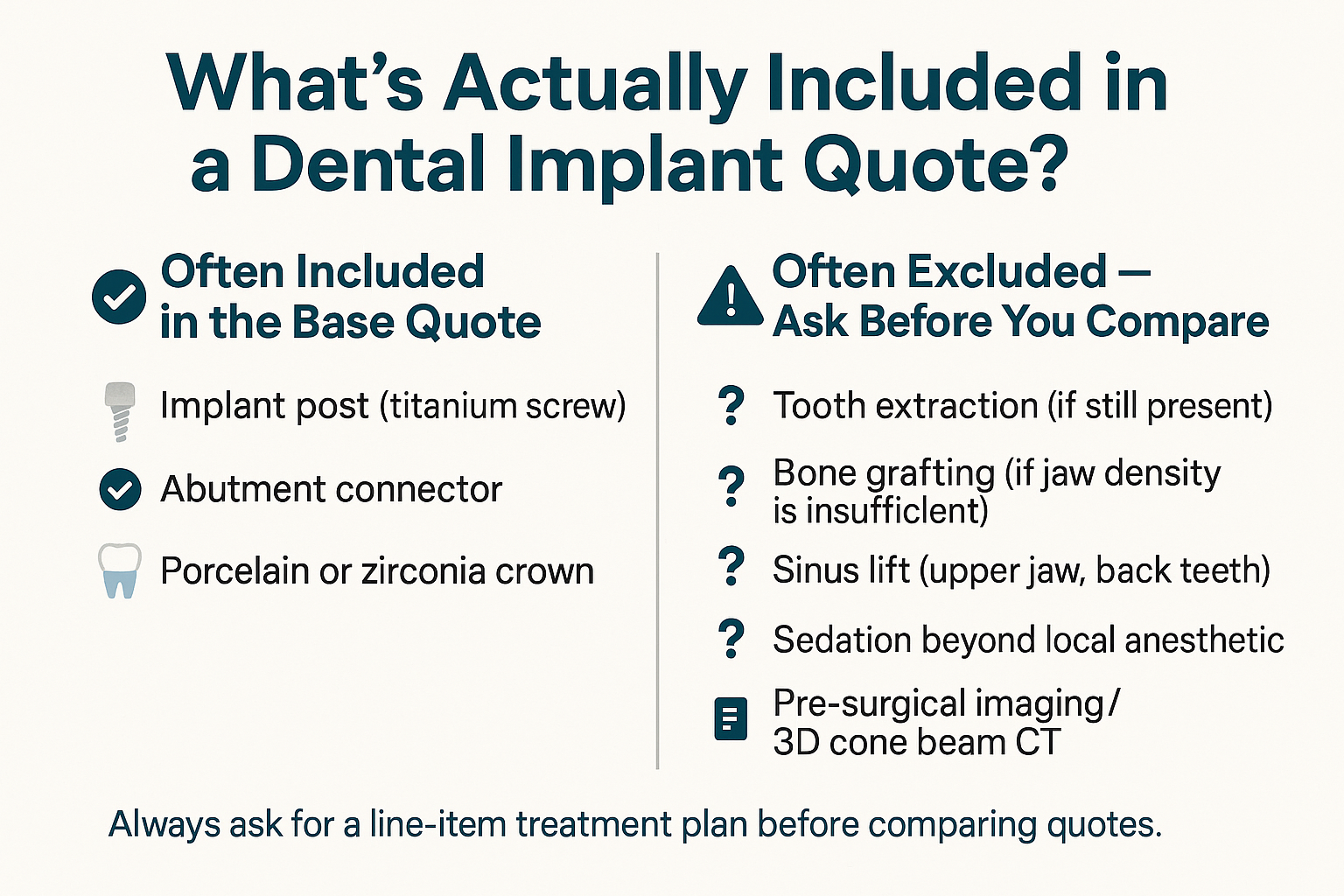
Some practices quote all three together. Others quote only the implant and abutment, with the crown billed separately. And nearly every advertised price excludes any preparatory work — things like an extraction if the tooth is still present, bone grafting if there isn’t enough jaw structure to support the post, or a sinus lift if the implant site is in the upper back of the mouth.
I’ve seen patients comparing quotes who didn’t realize one number included a bone graft and another explicitly excluded it. That gap alone can account for $800 to $3,000 in additional cost depending on the extent of bone loss. Understanding what bone grafting involves before you get quoted helps you ask smarter questions when you’re comparing options.
What a Simple Case Costs vs. One That Needs More Prep
The best way I can illustrate the range is to walk through two realistic scenarios.
Scenario 1 — The straightforward case:
The tooth is already gone, the jawbone is healthy and has enough density to support the post, and the patient doesn’t need sedation beyond local anesthetic. In this situation, the total cost for implant, abutment, and crown in the South King County market generally falls somewhere in the $3,000 to $4,500 range — though your actual quote will depend on the specific materials used and the provider you see.
Scenario 2 — Bone grafting required:
This is where the range widens. When a tooth has been missing for a while, or was removed due to infection, the jawbone underneath often loses density. Before an implant post can be placed, that bone needs to be rebuilt. Bone grafting is a separate procedure with its own healing timeline — often three to six months before implant placement can even begin. Adding grafting to the treatment plan can push total costs toward the $5,000 to $7,000 range, sometimes higher depending on the extent of work needed.
If the implant site is in the upper jaw near the sinus cavity, a sinus lift may also be required to create enough vertical bone depth. That adds both cost and time to the process.
For patients weighing whether an implant makes sense given their specific situation, the comparison article on crown vs. bridge vs. implant decision-making is worth reading before any consultation.
What’s Actually Included in a Dental Implant Quote
This breakdown shows the components that may or may not appear in an advertised implant price — and why two quotes for ‘the same thing’ can vary by thousands of dollars.
How to Read a Quote You’ve Already Received
If you’ve called around and gotten a price — or seen one advertised — here’s what to check before treating it as a real comparison.
A nearby practice in Renton currently advertises a bundled implant, abutment, and crown price that explicitly excludes extractions and bone grafting. For many patients, that’s not a problem — they may not need those procedures. But for someone with bone loss or a tooth that still needs to come out, that advertised number is just a starting point, not a realistic total.
When you receive a quote, ask:
- Does this include the crown, or just the implant and abutment?
- Is an extraction included if the tooth hasn’t been removed yet?
- Has anyone evaluated whether I’ll need bone grafting?
- What imaging is included — and is a cone beam CT scan already factored in?
- What level of sedation is included, and what would additional sedation cost?
These aren’t trick questions. Any practice that gives you a thorough treatment plan should be able to answer all of them before you commit to anything. And if bone grafting does come up in your consultation, this article on what bone grafting actually involves explains the process and timeline in plain terms.
Typical Cost Components for a Single-Tooth Implant
These ranges reflect general market context in the greater Seattle and South King County area. Actual costs vary by case complexity, materials, and provider — your treatment plan will give you the real numbers.
| Component | Included in Base Quote? | Estimated Cost Range |
|---|---|---|
| Implant post + abutment | Usually yes | $1,500 – $3,000 |
| Crown (porcelain or zirconia) | Sometimes — ask | $1,000 – $2,000 |
| Tooth extraction | Rarely | $150 – $400 |
| Bone grafting | No — billed separately | $800 – $3,000+ |
| Sinus lift | No — billed separately | $1,500 – $3,000 |
| Cone beam CT / 3D imaging | Varies by practice | $150 – $400 |
| Sedation (beyond local) | Rarely included | $200 – $600+ |
What Insurance Actually Covers — and the Part Most People Get Wrong
I hear this a lot from new patients: ‘I just got insurance through work, so I figured I should finally get this taken care of.’ That instinct is exactly right. But understanding what your plan will and won’t cover helps you plan the timing and the out-of-pocket cost realistically.
Most dental insurance plans do not cover implant placement itself. The implant post is typically classified as a non-covered service under many traditional dental plans, including most Delta Dental PPO tiers.
But here’s where it gets more useful: insurance often does cover adjacent procedures:
- Tooth extraction — usually covered as a basic or major service, depending on your plan
- Bone grafting — some plans cover a portion when it’s medically necessary, though many don’t
- The crown — many plans cover a percentage of crown costs (often 50%) under their major restorative benefit
So even if your plan won’t pay for the implant itself, you may get meaningful help on the extraction, possibly some on the graft, and partial coverage on the final crown. That can realistically reduce your out-of-pocket cost by $500 to $1,500 or more depending on your plan.
One more thing worth knowing: most plans have an annual maximum — commonly $1,000 to $2,000 per year. If your implant treatment spans two calendar years (for example, bone grafting in November and implant placement the following spring), you may be able to apply benefits in both years and meaningfully reduce what you pay in any single year. This is a legitimate strategy that’s worth discussing with whoever handles benefits coordination at your practice.
Frequently Asked Questions About Dental Implant Costs
Why did I get quoted $4,500 at one place and $7,000 somewhere else for the same thing?
Almost always, the difference comes down to what’s included. One quote may cover only the implant and abutment while the other includes the crown, imaging, and pre-surgical evaluation. Ask both offices for a line-item breakdown and check whether bone grafting or extraction has been assessed — those two items alone can account for thousands in cost difference.
I’ve been putting off replacing a missing tooth for a few years. Does that change anything about the cost?
It can, yes. When a tooth has been missing for an extended period, the jawbone in that area often shrinks due to lack of stimulation. That bone loss may require grafting before an implant can be placed — which adds both cost and healing time to the process. A cone beam CT scan at your consultation will show the current bone density and determine whether grafting is part of your treatment plan.
My insurance just kicked in through work. How do I use it wisely for an implant?
Start by finding out your plan’s annual maximum and which services are covered under major restorative benefits. Even if the implant post itself isn’t covered, your plan may cover the extraction, a portion of bone grafting, and part of the crown cost. If your treatment will span multiple phases, ask about strategically timing procedures across two calendar years to apply your annual maximum twice. Getting a pre-authorization for covered services before treatment begins also helps avoid billing surprises.
What’s the difference between bone grafting and a sinus lift? Are those the same thing?
They’re related but distinct procedures. Bone grafting rebuilds lost jaw density that has diminished over time or after extraction — it can be needed anywhere in the mouth. A sinus lift is a specific type of grafting procedure used only in the upper jaw when the sinuses sit too close to the implant site and there isn’t enough vertical bone height. Both add time and cost, but they address different anatomical situations.
Does the crown material affect the price?
Yes. Zirconia crowns are generally more durable and aesthetic but cost more than traditional porcelain-fused-to-metal options. For most visible teeth, zirconia is the more common recommendation today. The difference in crown material typically falls in the $200 to $500 range, though your quote will reflect the specific recommendation for your case.
Can I do this in phases to manage the cost?
In many cases, yes — and it’s actually how implant treatment naturally works. Bone grafting (if needed), implant placement, and the final crown are separate stages with healing periods in between. That built-in spacing gives you the opportunity to stage insurance benefit use across calendar years and spread out-of-pocket costs across multiple months. Ask your dental team to map out the treatment timeline and identify where the billing stages fall.
Want a Straightforward Answer for Your Specific Situation?
Every implant case is different, and the only way to get a number that actually reflects your situation is a proper consultation with imaging. At Cedar Dental Group, we include Dr. Jaewon Kim — a board-certified periodontist — on-site for cases that involve bone grafting or surgical preparation, which means patients don’t need separate referrals to get a complete picture of what their treatment will involve. If you’re in Renton or the surrounding South King County area and want to understand what your case would realistically require, you can reach us at 425-430-0400 or visit cedardentalgroup.com to schedule a consultation.
